Fixing Low Water Pressure from Scale Buildup in Bullhead
Diagnose and solve low water pressure caused by severe Colorado River mineral scale crusting in Bullhead City, AZ homes. Expert field guide.


When water flow drops to a disappointing trickle across your fixtures, the root cause in Bullhead City is almost always aggressive mineral scale constriction driven by the heavy calcium and magnesium load of the Colorado River. As hard water travels through home plumbing networks, constant temperature shifts—especially during 115°F-plus summer months—precipitate dissolved minerals out of solution. These minerals adhere to pipe interior walls, narrowing the internal diameter of the conduit and choking dynamic hydraulic head pressure.
How Colorado River Hardness Constricts Pipe Interiors and Chokes Flow
The municipal water supply drawn from the Colorado River carries a massive Total Dissolved Solids (TDS) count, frequently exceeding 300 to 500 parts per million. When this water is heated or subjected to friction within supply lines, calcium carbonate and magnesium sulfate rapidly crystallize into a rock-hard crust known as scale. This encrustation does not form evenly; it favors turbulent zones such as elbows, tees, and the interior ridges of galvanized steel nipples or shutoff valve seats. Over time, a 3/4-inch supply line can have its effective internal diameter reduced by half or more, drastically lowering the volume of water that can reach your faucets and showers under normal pressure.
Isolating Flow Restrictions at Aerators, Cartridges, and Angle Stops
Before assuming your entire main supply line is choked with scale, you must systematically isolate the restriction points. Begin by unscrewing the aerator screens on your bathroom and kitchen faucets. In the Tri-State area, these screens frequently capture gritty white or yellowish mineral debris that acts like a dam against water flow. Next, disconnect supply lines beneath sinks to check if the angle stops—the local shutoff valves—are partially seized or blocked by loose scale chunks broken free from upstream pipes. If removing the aerator restores full pressure at a specific fixture, your problem is localized. If pressure remains uniformly low across all hot and cold fixtures, the restriction lies within the main water service entry or water heater supply.
The Thermal Expansion Trap: How Desert Heat Accelerates Scale Crystallization
Bullhead City’s extreme ambient summer heat creates a punishing thermodynamic environment for residential plumbing. As outdoor temperatures soar, water sitting idle in uninsulated service lines or attic-routed PEX experiences accelerated thermal escalation. Higher water temperatures dramatically lower the solubility threshold of calcium carbonate. This means minerals drop out of suspension far faster inside a hot Arizona home than they would in a temperate climate. Furthermore, this intense heat cooks the scale directly onto the heating elements and interior tank walls of storage water heaters, creating a thick insulating blanket that not only starves downstream pressure but also causes premature tank failure through localized overheating.
Overlooked Field Insights: Seized Valves and Manufactured Home Cross-Connections
Standard plumbing guides often miss the unique vulnerabilities present in the housing stock along the Colorado River valley. In many manufactured and mobile homes common throughout Bullhead City, Fort Mohave, and Mohave Valley, water supply lines run through the underbelly enclosed by a protective belly board. When minor leaks occur due to scale-stiffened joints or thermal fatigue, the belly board traps water, rotting subfloors before any pressure drop is noticed at the tap. Additionally, mineral scale frequently acts like cement around the internal packing nuts of gate valves and older compression angle stops. Forcing a mineral-locked valve without backing up the stem frequently snaps the internal brass gate, turning a simple pressure diagnostic into an emergency main-line shutoff scenario.
Safe Homeowner Triage Versus High-Risk Plumbing Procedures
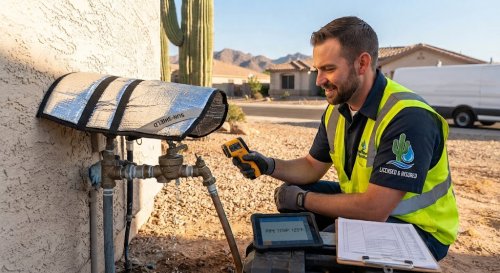
Homeowners can safely perform several initial diagnostic steps using basic tools. You can attach a standard water pressure gauge to an exterior hose bibb to verify static versus dynamic municipal supply pressure. You can also soak removable faucet aerators and showerheads in a warm vinegar or commercial descaling solution overnight to dissolve external crust. However, strict safety boundaries apply. Never attempt to force rusted main shutoff valves located at the property line or utility meter box without proper meter keys and torque control. Avoid applying liquid chemical drain cleaners to clear supposed pressure clogs—these exothermic chemicals generate extreme heat that easily warps PVC drain traps and releases toxic fumes in confined desert utility spaces.
Comparative Analysis: Localized Fixture Restriction vs. Main Supply Line Scale Choke
| Diagnostic Indicator | Localized Fixture Restriction | Main Supply Line Scale Choke |
|---|---|---|
| Affected Outlets | Only specific faucets or showers experience low pressure. | All hot and cold fixtures throughout the entire house show reduced flow. |
| Water Temperature Impact | Typically affects hot and cold equally unless isolated to a single water heater feed. | Hot water flow drops noticeably faster due to rapid scale formation inside the heater. |
| Primary Diagnostic Test | Remove and inspect faucet aerator screens and angle stop output. | Attach a pressure gauge to the main hose bibb while running multiple interior taps. |
| Typical Remediation | Soak parts in descaling solution or replace clogged cartridges and angle stops. | Professional descaling flush, water softener installation, or targeted pipe repiping. |
Frequently Asked Questions
Can a water softener reverse existing mineral scale buildup inside my home's pipes?
A water softener prevents new scale from forming by removing calcium and magnesium ions via ion exchange, but it will not magically dissolve heavy, rock-hard accumulations already plastered inside older pipes. While softened water is slightly undersaturated and can slowly leach minor mineral deposits over many months, heavily restricted lines generally require chemical descaling flushes or physical replacement to restore original interior diameter and flow volume.
Why does my water pressure drop significantly only when using hot water?
When pressure loss is isolated to the hot water side, the culprit is almost exclusively scale accumulation inside your water heater tank or the hot water outlet nipple. As hard Colorado River water is heated day after day in extreme desert temperatures, minerals precipitate directly onto the dip tube and heating elements, restricting the volume of water exiting the tank and feeding your distribution lines.
How can I tell if my pressure regulator (PRV) is failing instead of my pipes scaling up?
A failing Pressure Reducing Valve (PRV) typically causes sudden, erratic pressure fluctuations or complete pressure loss across every fixture simultaneously, whereas mineral scale builds up gradually over months or years. Attaching a pressure gauge to your hose bibb will reveal if your PRV has seized; a healthy PRV should maintain a steady reading between 50 and 75 PSI when no water is running.
Is it safe to use commercial liquid descalers in my drinking water lines?
No. Standard commercial chemical descalers and industrial acid washes are toxic and not rated for potable water distribution systems unless specifically certified as food-grade and thoroughly flushed afterward. Using unapproved chemicals risks contaminating your drinking water and corroding metal pipe walls or rubber seals.
Why do Bullhead City plumbing fixtures crust over with white scale so quickly?
The municipal water supply serving the Bullhead City and Laughlin region naturally contains high concentrations of dissolved minerals due to the geological composition of the Colorado River basin. When water evaporates on fixture surfaces or is subjected to the high ambient thermal energy of our desert climate, the water molecules vanish into the air while leaving behind solid calcium and magnesium deposits.