When Desert Minerals Cement PEX and Copper Connections Shut
Discover how Colorado River mineral scale seizes plumbing valves in Bullhead City homes, and how to safely troubleshoot restrictive water flow.


When corrosive mineral-laden water from the Colorado River meets household fixtures in Bullhead City, dissolved calcium carbonate and magnesium rapidly precipitate out of solution, hardening into a rock-like crust that permanently cements internal plumbing connections shut. The primary physical mechanism behind this failure is extreme thermal precipitation combined with accelerated evaporative scaling. As superheated water sits idle in supply lines during peak desert temperatures exceeding 115°F, dissolved minerals crystallize directly onto brass seats, valve stems, and pipe interfaces. This mineral bridge fuses moving parts together, rendering quarter-turn valves immovable and severely restricting interior pipe diameters until total flow obstruction occurs.
The Mineral Crust Catalyst Behind Locked Isolation Valves
In local properties stretching from Fort Mohave up to Laughlin, standard brass ball and gate valves are exceptionally vulnerable to mineral lock. The microscopic tolerances between the valve stem, packing nut, and housing act as a catchment zone for calcium scale. When a homeowner attempts to close a seized valve during an emergency, the excessive torque applied to the handle frequently shears the internal brass stem right off at the housing. This leaves the internal ball stuck in the open position while snapping the exterior control lever entirely. The problem is exacerbated by the chemical composition of local municipal water supplies, which carry high Total Dissolved Solids (TDS) that act as an abrasive slurry every time a fixture is opened or closed.
Thermal Expansion Stresses on Scaled PEX and Copper Interfaces
Desert thermal dynamics play a destructive role in how scale interacts with modern and legacy pipe materials. Attic PEX runs and crawlspace copper lines experience dramatic diurnal temperature swings, expanding and contracting daily. When heavy calcium scale coats the interior walls of a copper-to-PEX crimp fitting or a threaded dielectric union, the scale loses its flexibility long before the host metal does. The rigid mineral deposit acts as a wedge, stressing the underlying pipe wall and widening the microscopic gap between barb fittings and cinch clamps. Over successive summer heat cycles, this continuous mechanical stress breaks down the integrity of joint seals, producing slow, hidden weeping leaks that frequently go unnoticed until structural subfloor rot sets in.
Unseen Field Realities: Why Chemical Descalers Fail in Closed Loops
Standard retail diagnostic advice often recommends pouring harsh chemical descalers or liquid drain cleaners into scaled systems to dissolve restrictions. However, in closed domestic water loops typical of Mohave Valley manufactured homes and stick-built residences alike, this practice is fraught with hidden hazards. Chemical acids react violently with heavy calcium deposits, generating severe thermal spikes that can melt schedule-40 PVC drain traps or warp thin-walled polybutylene distribution lines. Furthermore, partial dissolution of a massive scale crust breaks the deposit into sharp, jagged particulate chunks. These mineral shards travel downstream, instantly jamming ceramic cartridges in high-end shower valves, clogging aerator screens, and permanently scoring appliance inlet solenoids.
Safe Homeowner Diagnostics Versus High-Risk Interventions
Homeowners can safely perform several non-invasive diagnostic checks to assess the severity of mineral restriction without risking catastrophic water damage:
- Meter Flow Indicator Test: Verify all indoor fixtures are closed, then observe the low-flow indicator triangle on the property's main water meter to check for stealth continuous movement indicating a calcified leak.
- Thermal Differential Scanning: Use an infrared thermometer along exposed supply lines to map sudden temperature drops or hot spots that isolate where severe mineral constriction is disrupting flow dynamics.
- Aerator Screen Inspection: Unscrew sink faucet aerators and examine the mesh screens; heavy white or amber crystalline buildup here reliably indicates the advanced stage of whole-home scaling.
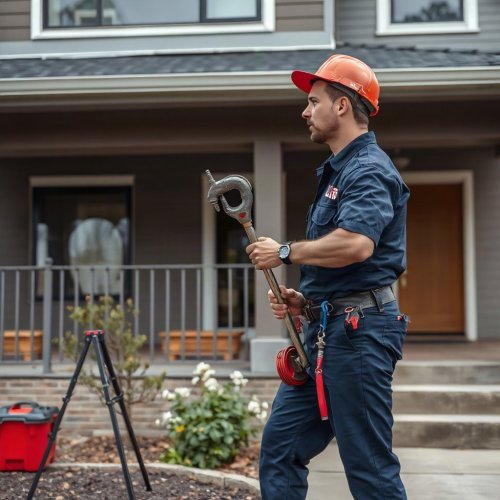
Strict Safety Boundary: Never apply a pipe wrench or cheater bar to a seized main water shutoff valve if it is located on the municipal side of the meter box, and never attempt to cut into pressurized, scale-encrusted supply lines without immediate access to a functional upstream emergency cutoff.
Comparative Analysis of Mineral-Induced Plumbing Failures
| Failure Symptom | Underlying Root Cause | Safe Diagnostic Test | Recommended Corrective Action |
|---|---|---|---|
| Seized Quarter-Turn Valve | Calcium carbonate fusion between stem and packing nut | Gentle tap with wooden mallet while applying light manual pressure | Full valve body replacement with full-port brass equivalent |
| Sudden Pressure Drop at Fixture | Mineral scale flaking off and clogging cartridge inlets | Isolate hot and cold lines to isolate obstruction point | Cartridge ultrasonic cleaning or complete fixture core replacement |
| Weeping PEX-Copper Crimp Joint | Thermal expansion working against rigid mineral scale wedges | Visual inspection with high-intensity LED scope for moisture rings | Cut out fitting, flush line, and reinstall with stainless steel expansion system |
Frequently Asked Questions
Can I use a torch to heat a seized valve and melt the mineral buildup?
Applying an open flame to a seized valve is extremely dangerous. Excessive heat can destroy internal rubber seals, warp brass housings instantly, and ignite nearby structural framing or insulation in cramped desert attics and utility chases.
Why do my shower valves get stiff and crunchy after only two years?
High water hardness combined with extreme ambient temperatures causes accelerated mineral drop-out inside the pressure-balancing spool. The mineral crystals grind against the brass walls every time the handle moves, creating that characteristic crunchy feel.
Does installing a water softener reverse existing scale inside my pipes?
A water softener prevents new scale from forming by removing calcium and magnesium ions, but it dissolves existing hard crusts very slowly over many months. Heavily restricted lines usually require mechanical hydro-jetting or physical replacement to restore full flow.
What makes manufactured home plumbing more susceptible to mineral damage?
Manufactured and mobile homes often utilize smaller diameter supply lines and flexible underbelly piping that run through uninsulated floor cavities, exposing the water to extreme thermal swings that accelerate mineral precipitation.
Is it safe to force a stuck main shutoff valve with a pipe wrench?
Never use extended leverage or cheater bars on stubborn valves. The extreme torque will easily shear the internal brass stem, turning a minor restriction into a full-scale property-flooding emergency.