Troubleshooting Low Water Pressure in a Bullhead City Home
Learn how to diagnose and troubleshoot low water pressure in your Bullhead City home, from local mineral buildup issues to whole-house supply checks.

Understanding Low Water Pressure in Your Home
Dealing with a weak stream from your showerhead or a sluggish kitchen faucet can make everyday tasks frustrating. When water pressure drops, the underlying cause can range from a simple, localized blockage in a single fixture to a failing pressure reducing valve or regional utility changes.
In the arid climate of Bullhead City, Arizona, high mineral content in the municipal water supply frequently plays a major role in pressure issues. Understanding how to systematically narrow down the cause can help you identify whether you can fix the problem yourself or whether a larger repair is needed.
Is the Problem Isolated or Whole-House?
The very first step in troubleshooting low water pressure is determining whether the drop affects a single fixture, a specific area, or the entire house.
- Single Fixture: If only one faucet or showerhead has low pressure, the issue is almost certainly localized to that specific hardware. Aerators, showerhead nozzles, and internal cartridge valves are common culprits.
- Whole-House: If every tap, shower, and hose bib in the home experiences reduced flow, the problem lies within the main water supply line, the main shutoff valve, or the pressure regulator.
Common Causes of Localized Pressure Drops
When just one or two fixtures lose pressure, you can usually resolve the issue without professional help.
Mineral Buildup on Aerators and Showerheads
Bullhead City's hard water leaves behind mineral deposits, primarily calcium and magnesium, as water evaporates. Over time, these minerals accumulate inside faucet aerators and showerhead faceplates, physically blocking the tiny exit holes.
To check this, unscrew the aerator from the end of the faucet spout or detach the showerhead. If you see white, crusty deposits, soak the part in a solution of equal parts white vinegar and warm water for an hour. The acid in the vinegar dissolves the mineral scale without damaging the metal finish. Scrub gently with an old toothbrush and rinse thoroughly before reattaching.
Partially Closed Shutoff Valves
Beneath most sinks and behind specific toilets, you will find small angle stop valves. If someone bumped one of these valves during cleaning or maintenance, it may be partially closed, restricting water flow to that specific fixture. Ensure the handle or knob is turned completely counterclockwise to fully open the valve.
Common Causes of Whole-House Pressure Drops
If your entire home suffers from weak water pressure, the investigation requires looking at the main components where water enters your property.
The Main Water Shutoff Valve
Check the main water shutoff valve, typically located near the water meter outside or where the main line enters the house through the foundation or garage wall. If this valve is not fully open, it acts as a bottleneck for your entire plumbing system. Gate valves and ball valves should be checked to ensure they are positioned completely parallel to the pipe (for ball valves) or turned fully open (for gate valves).
Failing Pressure Reducing Valve (PRV)
Many homes in Bullhead City utilize a pressure reducing valve (PRV) installed on the main supply line shortly after it enters the property. Municipal water lines often deliver water at high pressures to ensure adequate supply across neighborhoods, and a PRV lowers that pressure to a safe level (typically between 50 and 70 psi) for residential plumbing fixtures.
Over time, the internal springs and rubber diaphragms inside a PRV wear out. When a PRV fails, it often fails in the closed position, which severely restricts water flow and causes a sudden drop in whole-house pressure. If your PRV is more than 10 to 12 years old and you have verified that the main shutoff is fully open, the PRV may need replacement.
Water Heater Restrictions
If low pressure occurs exclusively when using hot water while cold water pressure remains normal, the restriction is likely tied to your water heater. Sediment buildup at the bottom of tank-style water heaters can partially block the outlet pipe, or a failing thermal expansion tank or inline check valve can restrict the flow of heated water leaving the tank.
Practical Steps Before Calling for Help
Before spending money on a plumbing repair, you can perform a few simple observations to gather accurate information:
- Check with immediate neighbors to see if they are experiencing similar pressure drops. If a municipal water main repair or local utility fluctuation is underway, the issue is outside your property boundary and will usually resolve on its own.
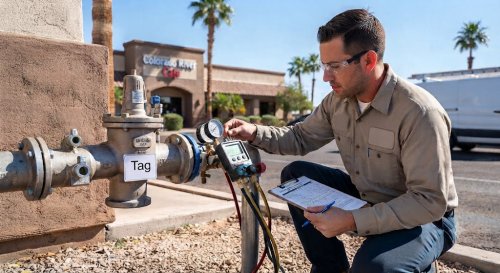
- Measure your water pressure using a simple pressure gauge that screws directly onto an outdoor hose bib. A standard reading below 40 psi generally indicates a supply-side restriction, such as a failing PRV or a partially closed main valve, while a reading within the normal range suggests the issue is isolated to interior piping or fixtures.
When to Seek Professional Diagnosis
While surface-level blockages and valve checks are manageable for most homeowners, certain indicators point to the need for professional diagnostic tools. If you notice a sudden, inexplicable drop in pressure accompanied by unexplained increases in your water bill, you may have a hidden underground leak or a slab leak.
Professional plumbers utilize specialized pressure testing equipment, acoustic leak detection, and thermal imaging to isolate underground supply line failures without tearing up landscaping or flooring unnecessarily. If your troubleshooting reveals a failed PRV or complex supply restriction, having a qualified technician replace the assembly ensures proper calibration and protects your home's appliances from excessive pressure spikes.