Solving Low Water Pressure Caused by Mineral-Clogged Lines
Discover how severe mineral scale chokes home supply lines in Bullhead City, causing dramatic pressure drops, and learn how to diagnose and clear it.


When your home experiences a sudden or progressive drop in flow velocity, low water pressure caused by mineral-Clogged supply lines is frequently the hidden culprit, driven by the aggressive calcium and magnesium saturation characteristic of Colorado River water. As hard water travels through domestic supply piping, continuous exposure to elevated indoor temperatures forces dissolved minerals out of solution, precipitating a hard, crystalline calcium carbonate crust along the interior walls of galvanized steel, copper, and even flexible PEX lines. This progressive scaling effectively shrinks the internal diameter of the pipe, restricting volumetric flow rates and starving fixtures of adequate hydraulic pressure.
The Mechanics of Mineral Chokepoints in Regional Plumbing Systems
Understanding how mineral accumulation strangles a plumbing system requires looking at the thermodynamics of residential water delivery. In Bullhead City, municipal and well water carries exceptionally high Total Dissolved Solids (TDS). When water sits stationary in supply lines—especially during scorching summer months when ambient temperatures inside wall cavities and unconditioned attics skyrocket—dissolved calcium rapidly plates out onto pipe walls. This process accelerates exponentially at directional changes, elbows, and threaded connections where turbulence encourages mineral precipitation. Over time, these crust layers thicken into rock-hard obstructions that choke off fluid dynamics, turning a standard 3/4-inch supply artery into a restricted channel barely capable of maintaining trickle-level flow.
Isolating Scale Restrictions from Municipal Supply Drops
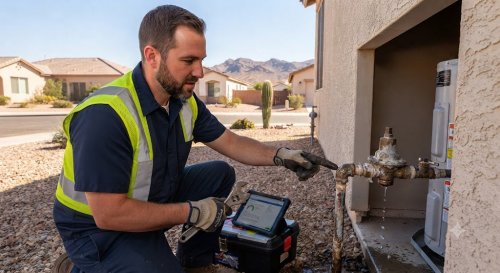
Pinpointing whether restricted flow originates inside your private supply lines or stems from the municipal water utility requires a systematic diagnostic approach. Begin by attaching a calibrated pressure gauge with a static pitot adapter to the exterior hose bib closest to the main water meter. Record the static pressure with all interior fixtures closed, then open a downstream indoor tap and record the residual dynamic pressure. If the static pressure reads within a normal range (50 to 70 PSI) but plummets dramatically the moment an interior fixture opens, the bottleneck resides inside your home's distribution piping. Conversely, if static pressure is universally low across all meter-adjacent points, the restriction lies externally with the regional utility supply.
Overlooked Field Secrets: Why Aerators and Shutoff Valves Fail First
Field experience in the Desert Southwest reveals that mineral scale rarely builds up uniformly throughout an entire plumbing network; instead, it targets specific localized choke points. Faucet aerators and showerhead flow restrictors act as primary filtration sieves, catching loose scale flakes dislodged from upstream pipes and instantly dropping effective flow to zero. More critically, angle stops and under-sink quarter-turn shutoff valves are prime casualties of heavy mineral saturation. The internal brass balls and stem packings become welded shut by crystalline crusting, meaning an attempted repair can easily snap the valve stem or prevent complete closure. Furthermore, in manufactured and mobile homes utilizing tight-radius PEX bends beneath subfloor assemblies, mineral deposits preferentially accumulate at these tight inflection points, creating severe localized friction losses that standard backwashing cannot clear.
Safe Triage vs. Dangerous DIY Intervention Boundaries
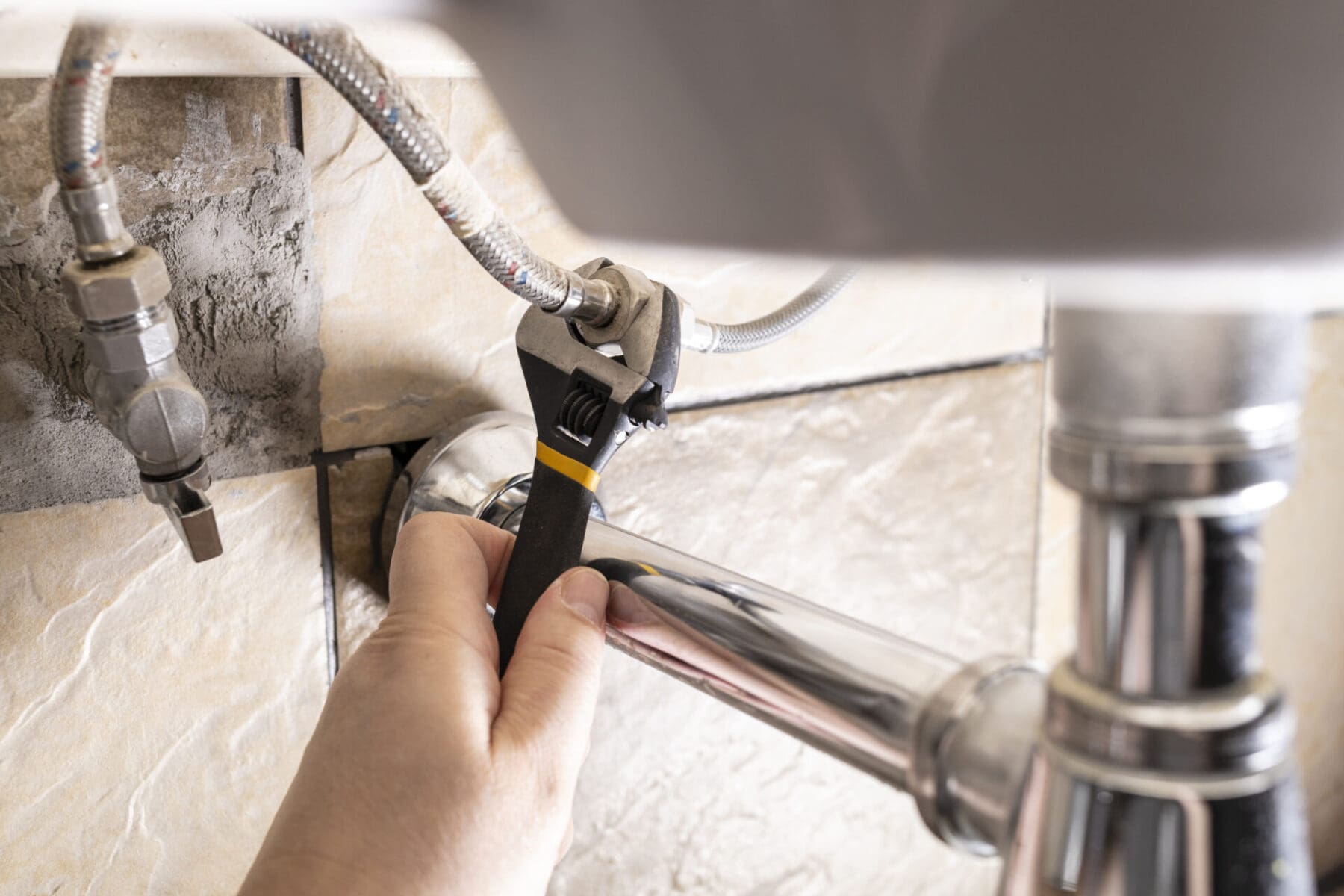
Homeowners can safely perform several initial triage steps to assess the extent of mineral-induced pressure drops without risking catastrophic water damage. You can unscrew and inspect faucet aerators, soaking them in a warm white vinegar solution to dissolve minor calcium bridges. You can also utilize digital water meter flow indicators to check for hidden continuous consumption or pressure drops when every home fixture is supposedly closed. However, you must strictly avoid aggressive DIY tactics such as pouring industrial muriatic acid or uninhibited chemical scale removers into home supply systems, as these harsh chemicals can rapidly corrode thin-walled copper or degrade older fittings, resulting in pinhole leaks behind finished drywall. Never attempt to force-twist seized main shutoff valves with heavy pipe wrenches if they resist initial torque; shearing a main valve body in a high-pressure line will immediately flood the interior space.
Diagnostic Comparison of Pressure Restriction Sources
| Failure Symptom | Primary Diagnostic Test | Typical Root Cause | Recommended Action |
|---|---|---|---|
| Sudden drop at a single sink | Remove and inspect faucet aerator screen | Loose scale debris trapped in aerator mesh | Clean or replace aerator insert |
| Low pressure throughout home when multiple taps open | Compare static vs. dynamic pressure at main hose bib | Internal pipe diameter reduction from heavy calcium scaling | Professional descaling or targeted repiping |
| Seized fixture shutoff valve refusing to turn | Visual inspection and gentle manual handle check | Mineral crystal fusion around brass stem packing | Replace angle stop valve entirely |
| Fluctuating hot water pressure only | Isolate water heater output valve and check test port | Calcification buildup inside water heater dip tube or tank bottom | Flush tank and replace sacrificial anode/dip tube |
Frequently Asked Questions
Can a water softener reverse existing mineral scale buildup inside my supply pipes?
A properly functioning ion-exchange water softener cannot actively dissolve thick layers of hard calcium carbonate that have already adhered to your pipe walls. What a softener accomplishes is halting future mineral precipitation by removing calcium and magnesium ions upfront. Over extended periods, softened water can slowly starve existing scale of new mineral layers, but heavy restrictions usually require chemical descaling or pipe replacement to fully restore inner diameters.
Why does my water pressure drop exclusively on the hot water side?
Thermal acceleration causes minerals to drop out of solution much faster at elevated temperatures. Your water heater acts as a primary collection zone for scale, where calcium precipitates and coats the interior tank walls, heating elements, and the hot water outlet dip tube. As the dip tube or outlet port becomes choked with scale debris, hot water delivery velocity drops significantly while cold water lines maintain normal flow.
Is it safe to use commercial liquid drain cleaners to clear mineral-clogged water supply lines?
No. Standard chemical drain openers are formulated strictly for wastewater drainage systems and DWV (Drain, Waste, and Vent) PVC or ABS piping. Introducing harsh caustic or acid-based chemical cleaners into pressurized potable water supply lines is extremely hazardous, as it can compromise pipe integrity, destroy seals, and introduce toxic chemicals into your drinking water.
How frequently should supply line shutoff valves be exercised to prevent mineral lock?
In high-hardness regions, angle stops and supply shutoff valves should be fully opened and closed semi-annually (every six months). Exercising the valve mechanism breaks up micro-crystals forming around the stem and packing nut before they can permanently fuse the brass components together, ensuring the valve remains operational for emergency isolations.
Do manufactured and mobile homes experience faster mineral scale restriction in supply lines?
Manufactured and mobile homes frequently feature smaller-diameter supply lines and routing through unconditioned underbelly spaces subject to extreme temperature swings. These thermal fluctuations accelerate mineral precipitation rates within the piping material, making manufactured housing particularly susceptible to rapid pressure degradation from scale accumulation.