Emergency Water Shut-Off Guide: What Every Bullhead City Homeowner Should Know
Learn how to find and operate your Bullhead City emergency water shut-off valve.

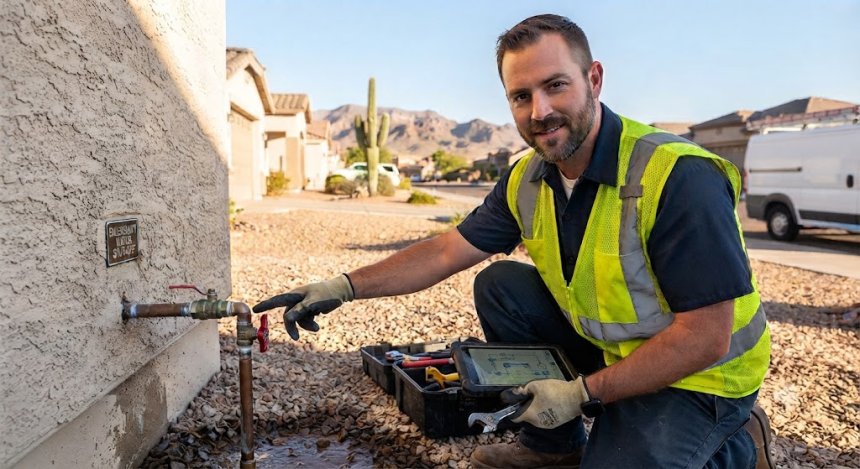
Introduction
Picture this: It's 2 AM, and you wake up to the sound of running water. You follow the noise to find a burst pipe spraying water across your kitchen floor. Every second counts, and water is damaging your home. But you have no idea where your shut-off valve is, and by the time you find it, thousands of dollars in damage have already been done.
Unfortunately, this scenario plays out far too often in Bullhead City. A burst pipe can flood a home within minutes, especially when water pressure is high. And in Bullhead City, water waste from correctable leaks is actually a violation of local regulations during drought restrictions . That means you're not just protecting your home—you're complying with city ordinances by fixing leaks quickly.
Knowing how to shut off your water is one of the most valuable skills a homeowner can have. It can save you from devastating property damage, lower your repair costs, and help you comply with local water conservation rules. This guide will show you exactly how to find your shut-off valve, operate it, and handle a plumbing emergency from start to finish.
Why You Need to Know Your Shut-Off Valve Location
In a plumbing emergency, speed is everything. The faster you stop the water flow, the less damage your home sustains. According to industry data, water damage claims account for nearly 30% of all homeowner insurance claims, making fast response critical to keeping repair costs manageable.
Bullhead City faces unique challenges that make knowing your shut-off valve even more important. During drought periods, the city enforces water restrictions that prohibit wasting water from correctable leaks . If a leak goes unrepaired, you could face violations. Additionally, Arizona's extreme heat, shifting soil, and aging plumbing infrastructure create conditions where pipe failures are more common.
Several factors can lead to plumbing emergencies in Bullhead City, including:
-
Temperature swings: Pipe expansion and contraction can cause cracks or burst joints .
-
Hard water: Mineral deposits can build up and accelerate pipe deterioration.
-
Aging pipes: Many Bullhead City homes have plumbing infrastructure that has reached the end of its lifespan.
During a plumbing emergency, a few minutes spent searching for a valve could be the difference between a simple cleanup and a flood that requires weeks of restoration work.
How to Find Your Bullhead City Main Water Shut-Off Valve
Every Bullhead City home has a main water shut-off valve. Finding it before an emergency hits is one of the smartest things you can do as a homeowner . In most homes, the valve is usually located within a few feet of where the water line enters the building.
Common Locations in Bullhead City
In Bullhead City and other warm climates, the shut-off valve is often located outside near the water meter . A Bullhead City customer's water supply system begins at the discharge point of the water meter .
Here are the most common places to check:
-
Front of the house near the hose bib (outdoor faucet): Many Bullhead City homes have their main shut-off valve here. Start at the front hose bib, which is the exterior faucet on the front of your house .
-
Near the water meter: You'll often find a covered box or vault near the sidewalk or property line. The water meter is typically in this box, and you may find a shut-off valve there as well. The water meter box is usually located near the street .
-
Ground-level box near the property line: Look for a small metal or plastic plate in the ground in front of your home, towards the street .
-
In the garage, along the front wall: Many Arizona homes have the main water shut-off in the garage, particularly on the front wall near the street .
-
Near the water heater: In older homes or those built on a slab, the shut-off valve is sometimes located near the water heater or under the kitchen sink .
If you have an older Bullhead City home or a home built on a concrete slab, the valve might be located in a crawl space, a utility room near the water heater, or outside the house.
Inside vs. Outside Valves
In warmer climates like Bullhead City, shut-off valves are often found outside to avoid freezing. However, you may also have a valve inside your home. Some Bullhead City homes have both an interior and exterior shut-off valve, with the interior valve serving as a more convenient shut-off point and the exterior valve at the meter providing a backup .
Special Considerations for Bullhead City
According to the city of Bullhead City, the public water supply system ends at the discharge point of the water meter . The plumbing system inside your property, including the shut-off valve, is considered the "customer water supply system." This means that while the city is responsible for the water up to the meter, the plumbing inside your property—including the valve you should close—is your responsibility .
How to Operate Your Shut-Off Valve
Once you've found your main shut-off valve, you need to know how to turn it off quickly. Most valves come in two styles: ball valves and gate valves .
Ball Valves (Lever Handle)
Ball valves are common in newer homes or updated systems. They have a lever handle that requires a simple quarter-turn to shut off the water. This is the faster and more reliable option.
-
How to close: Turn the handle 90 degrees until it's perpendicular to the pipe. If the handle is parallel to the pipe, the valve is open. If it's perpendicular, it's closed .
-
Why they are preferred: Ball valves are easy to operate, reliable, and less prone to seizing up compared to older gate valves .
Gate Valves (Wheel Handle)
Gate valves are commonly found in older homes. They have a round wheel handle that must be turned multiple times to fully close.
-
How to close: Turn the wheel clockwise until it stops. You will need to turn it many times, and you should feel resistance build as the valve closes .
-
Common issue: Gate valves can seize up if they haven't been operated in years. If you can't turn the valve, don't force it with a tool. You could break the valve entirely .
-
Prevention: Exercise your gate valve once or twice a year to prevent it from sticking. Just turn it a few times to make sure it moves smoothly and then return it to the open position .
What to Do If the Valve Won't Turn
If your main valve is stuck and you can't turn it off, you have one more option: the city-side valve at the water meter. This valve is usually located in the meter box near the street. You may need a water meter key (available at hardware stores for about $10) to access it .
Important: Only operate the customer-side valve closest to your house, not the city-side valve nearest the street. The city-side valve is the property of the water utility, and tampering with it could result in fines.
Step-by-Step Emergency Water Shut-Off Procedure
When a plumbing emergency happens, you need to act fast. Here's what to do:
Step 1: Locate and Shut Off the Main Water Supply
In a plumbing emergency, the goal is to stop the flow of water quickly. If you're dealing with a burst pipe, that means shutting off the main water supply valve to your home. Find your valve and turn it off.
If you're dealing with a localized leak—such as a broken supply line under a sink or a faulty toilet—you may be able to shut off the water directly at the fixture, like using the shut-off valve under the sink, rather than turning off water to the entire house .
Step 2: Open a Faucet to Release Pressure
After you shut off the main valve, open a faucet in your home, such as a sink or tub faucet . This will:
-
Drain remaining water from the pipes.
-
Relieve water pressure in the system, which can prevent a burst pipe from continuing to leak.
Step 3: Turn Off Your Water Heater
If you've shut off the main water supply, you need to turn off your water heater to prevent damage. If the water heater runs dry while it's still on, the heating element can overheat and break or even start a fire . You can also set the water heater to the "pilot" setting or flip the circuit breaker off to avoid dry-firing. This is a critical step if water has leaked near electrical sources .
Step 4: Address Electrical Hazards
Water and electricity are a dangerous combination. If you see water near electrical outlets, switches, or appliances, stay out of those areas. Turn off the circuit breakers for any affected zones if you can do so safely . Do not touch any electrical device with wet hands or while standing in water.
Step 5: Document the Damage
Before you start cleaning up, take photos and video of the damage. This documentation is essential for your insurance claim. Capture the source of the leak, the affected areas, and any damaged belongings .
Step 6: Call a Professional
Once you've contained the situation, call a licensed Bullhead City plumber. While you may have stopped the water flow, you'll still need a professional to make permanent repairs.
Temporary Fixes to Buy Time
While you wait for a professional to arrive, you can use temporary fixes to reduce active water loss . These are not permanent repairs but can buy you time.
-
Pipe repair clamps: These clamps have a rubber gasket that seals over a leak point. When you tighten the clamp, the gasket compresses against the pipe. This can stop or slow a leak on a metal, plastic, or multilayer pipe .
-
Plumber's tape: Teflon tape can create a watertight seal on threaded pipe connections. Wrap it clockwise around the male threads—two to three wraps for thicker tape, four to five for thinner options .
-
Turn off water-using appliances: While dealing with an emergency, switch off the dishwasher, washing machine, and any other water-dependent appliances to reduce demand on the system .
Do not use chemical drain cleaners during a water leak emergency. They are corrosive, release toxic fumes, and can make the underlying pipe condition significantly worse .
What to Do After the Water is Shut Off
The water is off, and you've called for help. But your work isn't over yet. Your actions in the next few hours can prevent long-term issues like mold growth. The EPA's mold prevention guidelines state that mold can begin growing on wet materials within 24 to 48 hours . Quick action is essential.
Immediate Steps
-
Move belongings: Move furniture, rugs, and anything absorbent away from wet areas . Place aluminum foil or wood blocks under furniture legs sitting on wet carpet to prevent further absorption .
-
Remove standing water: If you can do so safely, use towels, mops, or a wet/dry shop vac to remove as much standing water as possible .
-
Dry the area: Open windows and turn on fans to start air circulation. A dehumidifier will help remove moisture from the air .
Bullhead City's Water Restrictions and Leak Reporting
Bullhead City is in a drought-prone area and enforces water restrictions . During Tier 2 restrictions, the following activities are prohibited:
-
Allowing waste of water caused by correctable leaks, breaks, or malfunctions that are not fixed within 72 hours of notice .
-
Washing buildings or impervious surfaces.
-
Washing motor vehicles without an automatic shut-off nozzle.
-
Operating decorative fountains without recirculating systems.
-
Operating outdoor misting systems for cooling public areas .
If you have a leak, you have a limited time to fix it. In addition to the damage it can cause to your home, you could be violating city regulations. Report a large water leak immediately to Bullhead City's public works department.