Common Causes of Low Water Pressure in Bullhead City Homes
Discover why your Bullhead City home has low water pressure. Learn how to troubleshoot local hard water scaling, pressure regulators, and localized fixture issues.
Understanding Low Water Pressure in the Desert Climate
Dealing with a weak stream from your showerhead or kitchen faucet is more than just an annoyance; it can disrupt daily routines and occasionally point toward a developing plumbing issue. In Bullhead City, Arizona, low water pressure is a frequent complaint among property owners. Because the area features intense summer heat and mineral-heavy municipal water, local plumbing systems face unique environmental stresses that accelerate wear and tear.
When you turn on a tap and notice a sudden or gradual drop in flow, the first step toward a solution is figuring out whether the restriction affects a single fixture or the entire house. This simple distinction narrows down the possibilities immediately, saving you from chasing the wrong fix.
Single-Fixture Versus Whole-House Pressure Drops
The very first observation you should make is whether the problem is isolated to one location or happening everywhere.
- Single-Fixture Issue: If only the kitchen sink or a specific bathroom shower suffers from low pressure while the rest of the house flows normally, the restriction is almost certainly localized right at that fixture. Aerators, cartridge valves, or supply line shutoff valves are the usual suspects.
- Whole-House Issue: If every tap, shower, and hose bib in the home experiences weak flow simultaneously, the underlying cause involves your main water supply line, the main shutoff valve, or the pressure reducing valve (PRV).
Common Causes of Localized Pressure Drops
If your low water pressure is confined to a single sink, shower, or tub, you can often diagnose and resolve the issue without advanced tools.
Mineral Buildup on Aerators and Showerheads
Bullhead City water carries a high concentration of dissolved minerals like calcium and magnesium. As water evaporates at the tip of a faucet or the face of a showerhead, these minerals leave behind hard, white scale deposits. Over time, this scaling physically blocks the exit holes, choking off the water volume.
How to check: Unscrew the aerator from the tip of the faucet or remove the showerhead. If you see white crust or grit inside the screen, mineral scaling is your culprit. Soaking the part in a small container of white vinegar for an hour usually dissolves the buildup entirely, restoring normal flow once reattached.
Partially Closed Supply Valves
Underneath sinks, you will find small angle stop valves controlling the hot and cold water lines. If someone bumped these during cleaning or storage, or if a valve stem has slipped inside, the valve may be partially closed and restricting water volume.
Common Causes of Whole-House Pressure Drops
When the entire property experiences low water pressure, the problem stems from the main entry point or municipal supply.
The Pressure Reducing Valve (PRV)
Most homes in the region are equipped with a PRV—a brass bell-shaped device typically located where the main water line enters the house, often near the main shutoff valve. The PRV regulates the incoming high-pressure municipal water down to a safe level for household pipes, usually between 50 and 70 psi.
Over years of continuous operation, the internal springs and rubber diaphragms inside a PRV wear out, or mineral debris clogs its internal strainer. When a PRV fails, it often fails in a closed or restricted position, causing a dramatic drop in water pressure across the entire home. Adjusting the top bolt on an aging PRV rarely fixes a worn-out internal mechanism; replacement is usually necessary when these valves fail.
Main Shutoff Valve Restrictions
Whether it is the city gate valve, the property owner's main ball valve near the water meter, or the main indoor shutoff, any valve that is not fully opened will severely restrict volume. A quarter-turn ball valve must have its handle parallel to the pipe to be fully open. If it is slightly misaligned, pressure will plummet.
Hot Water Only Pressure Drops
If your cold water pressure is strong everywhere, but your hot water runs to a trickle, the issue lies specifically within your water heater supply chain or the tank itself. Sediment accumulation at the bottom of a water heater tank can migrate into the hot water outlet pipe, or scale can clog the inlet dip tube. Additionally, failing heat trap nipples or aging isolation valves on the water heater can restrict the outgoing hot water flow.
The Impact of Bullhead City’s Environment on Plumbing
The desert climate creates specific operating conditions for residential plumbing. Extreme summer ambient temperatures can cause thermal expansion in closed water systems, placing extra stress on valves, PRVs, and water heater relief valves. Furthermore, municipal water supplies sourced from the Colorado River region carry total dissolved solids (TDS) that contribute directly to the scaling seen on fixtures and inside water-using appliances.
Homeowners who use water softeners can mitigate mineral scale, but failing to maintain softener resin beds or salt levels can allow hard water to resume its silent accumulation inside pipes and valves.
Safe Troubleshooting Steps for Homeowners
Before deciding whether professional diagnosis is needed, you can safely perform a few diagnostic checks:
- Check multiple faucets and outdoor hose bibs to confirm if the pressure drop is universal.
- Inspect the main water meter box (if accessible and safe to open) to see if the city valve is fully open and whether the leak indicator dial is spinning while all indoor fixtures are turned off.
- Unscrew and clean faucet aerators and showerheads to eliminate scale blockages.
- Verify that all supply valves under sinks and near the water heater are completely open.
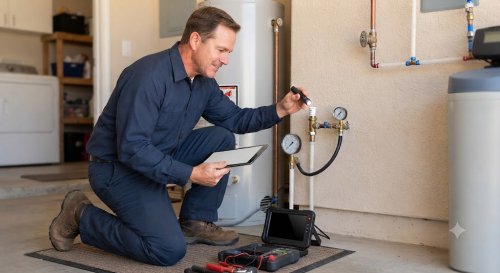
If these basic checks do not reveal a clear cause—or if you suspect a failing pressure reducing valve or a hidden leak in the main supply line—a licensed professional can use a pressure gauge attached to an outdoor spigot to accurately test static and dynamic water pressure and pinpoint the restriction.